

Views: 0 Author: Site Editor Publish Time: 2026-07-01 Origin: Site


Textile dyeing and leather finishing often depend on a difficult balance: the formulation must wet the substrate evenly, keep unlike ingredients compatible, and stay workable long enough to avoid premature drying. Dipropylene Glycol Monopropyl Ether (DPNP), CAS 29911-27-1, is used where that balance of solvency and controlled evaporation is valuable; regulatory records identify it as dipropylene glycol n-propyl ether and include 1-(1-methyl-2-propoxyethoxy)propan-2-ol among its names.
This makes DPNP relevant to dyeing, printing, and finishing systems where consistent distribution and predictable drying can directly affect process control and finished-product quality.
Textile and leather formulations rarely consist of ingredients with identical chemical behavior. A treatment bath, printing system, or finish may combine water with dyes or pigments, surfactants, resins, oils, softening components, and other auxiliaries, creating a formulation in which compatibility matters as much as the performance of any single ingredient. In this setting, DPNP can serve as a solvent or coupling component that helps bridge materials with different affinities and maintain a more workable liquid system. That role is different from the functions of a dye, fixing agent, binder, or surfactant: the glycol ether primarily supports the environment in which those ingredients are delivered.
This distinction matters on a production line. Better compatibility can help reduce local concentration differences, unstable blending, or inconsistent deposition caused by poorly integrated formulation components. The result formulators are seeking is not simply greater solvency, but a mixture that stays manageable during preparation, circulation, application, and the period before drying.
Typical DPNP characteristics include a boiling point of about 212°C, vapor pressure of around 10 Pa at 20°C, water solubility of approximately 150,000 mg/L at 20°C, viscosity near 7 mPa·s at 25°C, and relative density around 0.919 at 25°C. Together, these properties describe a liquid that does not flash off immediately and can remain present long enough to assist spreading and formulation contact with the substrate.
For textile or leather processing, that residence time can be useful when rapid solvent loss would otherwise cause uneven wetting or premature drying. A slower-evaporating component gives a treatment more time to distribute before the drying stage becomes dominant. The benefit is therefore process control rather than slow evaporation for its own sake; if the line already struggles with drying capacity, the same property has to be managed carefully.
DPNP Property | Effect in the Formulation | Textile/Leather Relevance |
Water and organic compatibility | Supports mixed-component systems | Helps maintain workable dye, auxiliary, or finish formulations |
Relatively low vapor pressure | Extends liquid residence time | Reduces premature drying during application |
Moderate viscosity | Supports practical blending and pumping | Useful in liquid treatment and finishing systems |
Solvent/coupling behavior | Helps integrate ingredients with different affinities | Supports more uniform delivery across the substrate |
Uniformity is one of the central challenges in textile wet processing. A dye bath or treatment liquor must keep its functional ingredients sufficiently dispersed or dissolved while also making reliable contact with the fabric. In formulations where a co-solvent is appropriate, DPNP can help carry and distribute compatible dyes or auxiliaries through the liquid phase, supporting more consistent application conditions.
That does not mean the solvent fixes color to the fiber or determines final shade by itself. Dye chemistry, fiber type, temperature, pH, fixation mechanism, liquor ratio, and process time remain separate variables. DPNP’s contribution is narrower: it can support the delivery environment, especially where water-based and more organic components need to coexist without creating an unstable or poorly wetting system.
The effect should always be evaluated on the actual substrate. A tightly constructed synthetic fabric, an absorbent cellulosic textile, and a coated fabric do not present identical wetting or drying conditions. Rather than assuming that one solvent level works across every line, formulators gain more useful information by measuring bath stability, fabric wet-out, shade uniformity, drying behavior, and surface residue under real processing conditions.
Printing introduces another problem: the formulation has to remain workable long enough to transfer cleanly while retaining the viscosity and distribution needed for controlled pattern formation. If volatile components disappear too quickly, a print paste or liquid system may change during application, affecting flow, open time, or the way colorants and binders are deposited. A slower-evaporating co-solvent such as DPNP can be considered when greater working time is needed.
Its usefulness is tied to balance. Extended open time may help reduce premature drying on application equipment or within a formulation exposed to air, but the printed textile still needs to dry efficiently afterward. Formulators therefore need to consider line speed, deposited weight, dryer temperature, airflow, and the evaporation behavior of the entire solvent package rather than evaluating Dipropylene Glycol Monopropyl Ether in isolation.
Finishing systems create a different formulation task from dyeing or printing. Resins, coating components, softening agents, pigments, or other functional additives may need to spread over the textile surface in a controlled and repeatable way before water and solvents are removed. Here, a compatible glycol ether can help maintain ingredient distribution and provide enough working time for a finish to wet and level more consistently.
DPNP should therefore be viewed as a processing aid within the formulation architecture rather than as the finishing chemistry itself. Its strongest case arises when a formulator needs solvent power, coupling behavior, and controlled evaporation at the same time. Whether those properties improve the finish depends on the resin system, fabric construction, application method, add-on level, and drying conditions, so bench and pilot trials remain more meaningful than a generic recommendation.
Leather presents a less uniform substrate than a flat, homogeneous industrial surface. Variations in fiber structure, porosity, previous processing, and surface condition can influence how treatment liquids contact and move through the material. In a dyeing or treatment formulation that contains both water-compatible and more hydrophobic ingredients, DPNP can act as part of the solvent/carrier system, helping maintain a workable mixture as it contacts the leather.
The practical target is even distribution rather than simply stronger solvent action. If the formulation wets poorly or separates during use, local differences in chemical delivery can contribute to non-uniform treatment. A properly balanced solvent package can support more consistent contact, although dye penetration and fixation still depend heavily on the dye system, leather condition, pH, temperature, processing time, and other auxiliaries.
Leather finishing shifts the emphasis from internal treatment toward controlled surface application. Pigments, resins, modifiers, and other finish components must remain compatible during spraying, coating, or related application steps, then level adequately before the coating dries. In these systems, DPNP can be considered when the formulation requires both solvency and enough evaporation time for satisfactory wetting and leveling.
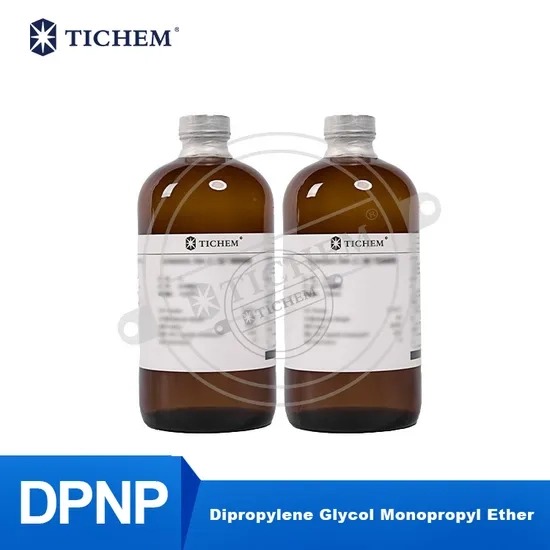
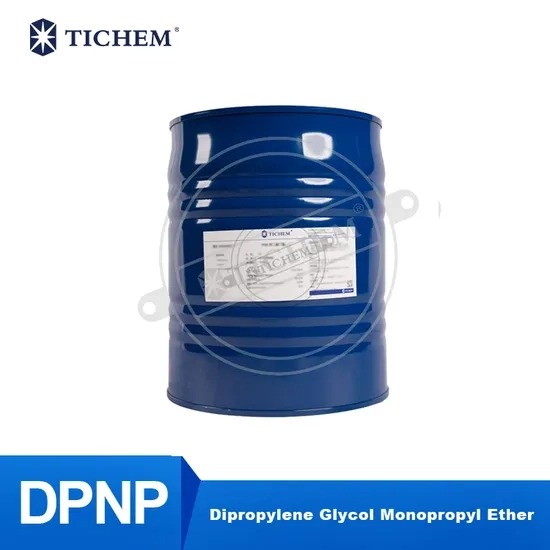
For industrial users moving from formulation testing to practical supply, TICHEM offers industrial-grade DPNP, including a 25 L option for textile and leather applications. The material is an industrial-grade, colorless transparent liquid with a stated purity of 98.5%. These characteristics fit the role of a controlled-evaporation solvent, but the production line still determines whether it is suitable. Heavy coating weights, high line speeds, low dryer capacity, or low processing temperatures can make excessive solvent residence undesirable, so formulation design has to match the actual drying window.
A useful formulation trial starts with a specific problem rather than a predetermined percentage of DPNP. Poor wetting, unstable compatibility, inconsistent application, rapid surface drying, or insufficient working time each point toward different adjustments, and increasing solvent concentration without identifying the cause can simply move the problem elsewhere. The first step is therefore to establish what is failing and define a measurable target for improvement.
Substrate type, dye or pigment chemistry, resin system, water-to-organic balance, viscosity, temperature, application method, and drying conditions should all be considered before changing the solvent package. For example, a textile printing formulation experiencing premature drying presents a different optimization problem from a leather finish showing poor leveling. The value of a trial comes from comparing controlled formulations under the same operating conditions rather than applying a universal dosage.
Useful evaluation criteria include formulation stability, wet-out, treatment or shade uniformity, surface appearance, drying time, and visible or measurable residue. Recording these variables also makes scale-up more reliable because the team can identify which improvement came from the solvent change and which resulted from another processing variable.
The feature that makes DPNP useful in one process can become a constraint in another. If a coating or textile treatment already dries slowly, adding more of a relatively high-boiling glycol ether may extend residence time beyond what the oven, airflow, or line speed can comfortably handle. Formulators should therefore judge performance across both application and drying stages rather than optimizing wetting while overlooking downstream throughput.
Small-scale compatibility and drying tests are particularly useful before changing a production recipe. A formulation that looks stable in a mixing vessel may behave differently after spraying, padding, printing, or exposure to elevated drying temperatures. Routine industrial handling should also follow the current SDS, workplace ventilation requirements, suitable PPE practices, and applicable storage or regulatory procedures.
Procurement deserves the same attention as formulation testing because similar abbreviations can refer to different glycol ethers. For the material discussed here, CAS 29911-27-1 is the most reliable identifier. Dipropylene glycol n-propyl ether and 1-(1-methyl-2-propoxyethoxy)propan-2-ol are among the names associated with this chemical identity. Using the CAS number on purchase specifications, test records, and technical documentation reduces the chance of choosing a chemically different solvent because of naming variation.
TICHEM supplies high-purity Dipropylene Glycol Monopropyl Ether with a stated purity of 98.5% as a colorless transparent liquid. Available formats include 1 L and 25 L options, while transport packaging can include iron drums, IBCs, and ISO tanks. Before scale-up, buyers should compare current product documentation and batch information against formulation requirements rather than relying on the product name alone.
DPNP should also not be confused with industrial-grade DPNB. Dipropylene Glycol Mono Butyl Ether (DPNB) uses CAS 29911-28-2, while DPNP is identified by CAS 29911-27-1. The one-letter difference therefore corresponds to a different chemical identity and property profile.
Process Symptom | When DPNP May Be Worth Testing | What to Check |
Poor wetting or uneven treatment | When the formulation needs additional solvent/coupling support | Wet-out and treatment uniformity |
Components show compatibility problems | When water-based and organic ingredients must coexist | Separation, haze, viscosity, storage stability |
Printing or coating dries too quickly | When more working time is needed before drying | Open time, line speed, final drying time |
Finish levels poorly | When additional wetting and controlled evaporation may help | Surface appearance and film uniformity |
Drying is already slow | Increasing DPNP may be counterproductive | Residual solvent, oven capacity, throughput |
Moving from lab to production | When formulation performance has already been validated | CAS, purity, COA/TDS/SDS, packaging and lot consistency |
For textile and leather processing, Dipropylene Glycol Monopropyl Ether (DPNP/CAS: 29911-27-1) is most valuable when formulations need a practical balance of solvency, wetting, ingredient compatibility, and controlled evaporation. Its role is not to replace dyes, binders, or finishing agents, but to help those systems remain workable and deliver more consistent application and drying performance.
Shanghai Tichem Industrial Co., Ltd. supplies DPNP for industrial applications, giving formulators and procurement teams an option for testing, production planning, and scale-up where reliable solvent performance can support more stable textile and leather processes.
A: DPNP is an industrial glycol ether used as a solvent, coupling agent, and carrier in applications including textile processing, leather treatment, coatings, inks, and cleaning formulations.
A: Its balance of hydrophilic and hydrophobic properties helps compatible formulation components remain distributed, while its relatively slow evaporation can support wetting, working time, and controlled application.
A: Yes. Commercial DPNP is commonly identified as dipropylene glycol n-propyl ether and can occur as a mixture of structural isomers sharing the molecular formula C9H20O3.
A: In leather formulations, DPNP can function as a solvent or carrier, helping treatment ingredients remain workable and supporting more uniform wetting and distribution during dyeing or finishing operations.
A: Evaluate substrate type, formulation compatibility, required working time, drying conditions, and final performance. Small-scale testing is preferable because the suitable concentration depends on the complete processing system.


